The Hidden Geometry of the Kitchen
Kitchenware is arguably the most aggressively optimized class of household objects. What appears to be aesthetic flair is almost always a solution to thermal dynamics, structural integrity, or spatial efficiency.
The Pasta Spoon Hole
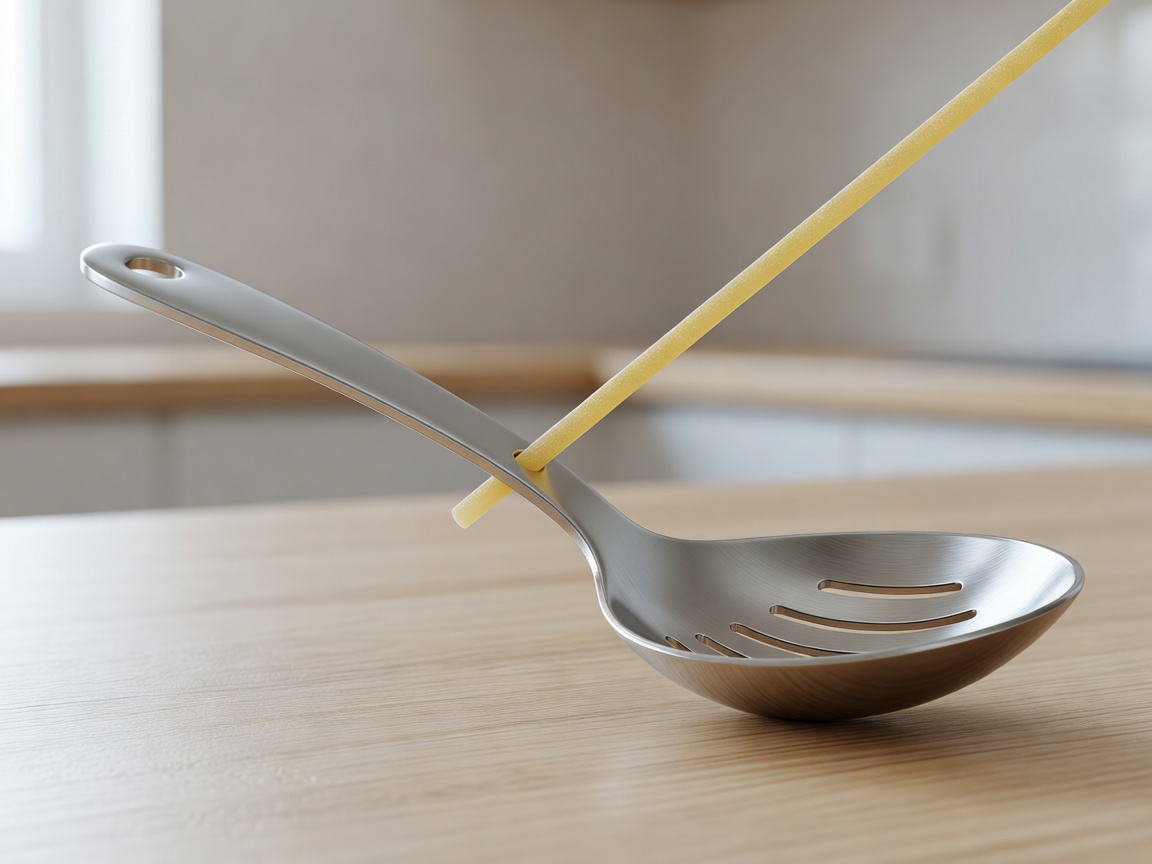
The jagged plastic or metal spoon you use to scoop spaghetti invariably has a large hole in the center. While it does drain water, its primary engineering directive was serving as a measurement gauge. The diameter of standard commercial pasta spoon holes yields exactly one portion (approximately 2 ounces) of dry spaghetti.
The Pot Handle Loop
Most saucepans feature a slotted or circular hole at the end of the handle. Historically, this was meant for hanging copper pots on ceiling racks in crowded 19th-century French kitchens. Today, modern industrial design retains this feature for a secondary purpose: functioning as a rest for a messy stirring spoon, allowing sauce to drip back into the pot rather than onto the stovetop.
The Wooden Spoon Over Boiling Water
This isn't a feature of the spoon itself, but a chemical and physical exploit of its material. Wood is an excellent insulator. When placed across a boiling pot of starchy water (like pasta or potatoes), the dry, relatively cool wood destabilizes the rising starch bubbles upon contact, forcing them to retreat and preventing a boil-over. The simplicity of the shape hides profound thermal physics.